15 Best Places to Visit in India in 2026

India spans nearly 1.3 million square miles (3.3 million square kilometers), and no two corners of it feel alike. That single fact should shape how you choose your places to visit in India. A traveler who tries to cover the Himalayas, the Rajasthani desert, and the Kerala coast in ten days ends up seeing airports. The people who come home glowing are the ones who picked a region and gave it room to breathe.
The best places to visit in India fall into four broad clusters: the Mughal north around Delhi, Agra, and Rajasthan; the Himalayan belt from Ladakh across to Darjeeling; the western coast running from Mumbai down through Goa; and the tropical south, anchored by Kerala. Most first trips take on two of them, and that is plenty.
What follows is not a ranking. It is a route through the country, north to south, ending offshore. Take the pieces that fit your dates.
Where Should You Visit in India?
1. The Taj Mahal, Agra
Photographs prepare you badly for the Taj Mahal. What they cannot show is the scale, or the way the white marble shifts from pale gray at dawn to warm gold by late afternoon. Shah Jahan commissioned it as a mausoleum for his wife Mumtaz Mahal, and the work took roughly two decades, wrapping up around 1653. UNESCO added it to the World Heritage list in 1983.
Two details save you a lot of frustration. The monument closes on Fridays for prayers, and the crowds thin dramatically if you arrive at opening rather than mid-morning. Gates run sunrise to sunset, though times shift with the season, so it is worth checking before you go.
Agra sits about 140 miles (225 kilometers) south of Delhi, close enough for a day trip but better as an overnight. If you want the mausoleum and the sandstone fort in one morning without queueing twice, the private Taj Mahal and Agra Fort tour handles both. For a quieter angle, the Mehtab Bagh and Itimad-ud-Daulah tour crosses the Yamuna to the garden that frames the Taj from behind, with almost nobody else there.
2. Delhi
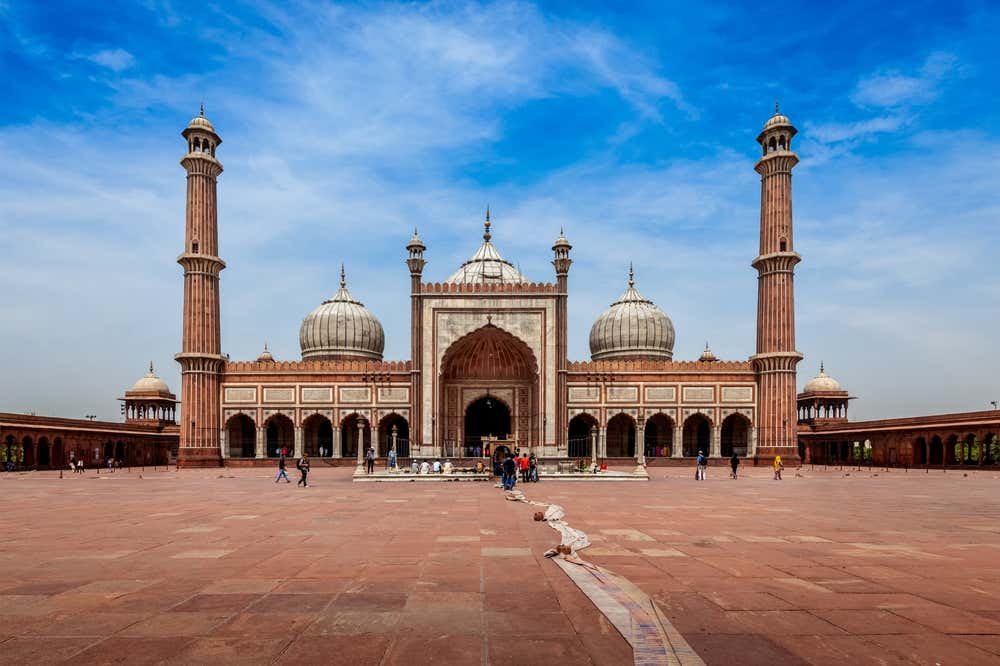
Delhi is really two cities stitched together. Old Delhi is the Mughal capital: narrow lanes around Chandni Chowk, the red sandstone bulk of the Jama Masjid, spice markets that clear your sinuses from thirty feet away. New Delhi is the colonial grid, wide and green, with Lutyens’ government buildings and the long lawns of Rajpath.
Three UNESCO World Heritage Sites sit inside the city limits. The Qutub Minar rises about 240 feet (73 meters) and dates to the late twelfth century. Humayun’s Tomb, finished in 1572, is the Mughal garden tomb that the Taj Mahal would later refine. The Red Fort held the imperial court for two hundred years.
A guide earns their keep here, mostly by getting you through Old Delhi without losing an afternoon to wrong turns. The free walking tour of Delhi is a solid first morning, and if you would rather set your own pace, the private tour of Delhi covers the Red Fort, Gandhi’s memorial, and the quieter tombs in between.
3. Jaipur
Jaipur was painted pink in 1876 to welcome the Prince of Wales, and the city never washed it off. The color reads more terracotta than pink in person, and it holds the light beautifully around dusk.
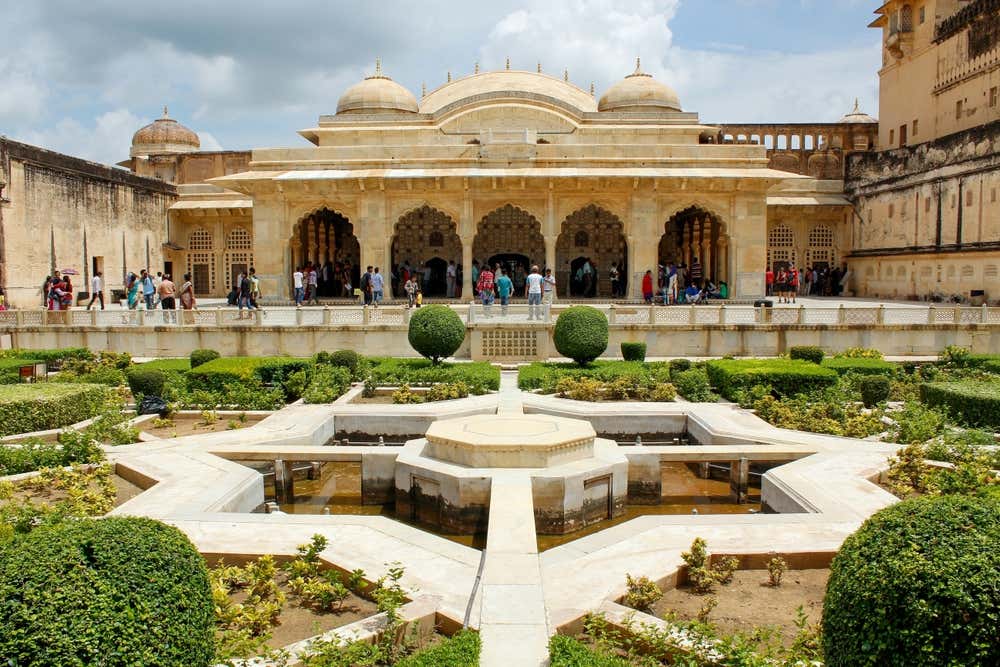
The Hawa Mahal is the postcard: a five-story screen of 953 small windows, built so royal women could watch street processions unseen. Amber Fort, about 7 miles (11 kilometers) north, is the one that actually takes a morning, with its mirrored hall and ramparts running up the ridge. Jantar Mantar, an eighteenth-century observatory of enormous stone instruments, is another World Heritage Site and takes barely an hour.
The old city rewards walking, and the free walking tour of Jaipur is a good way to get your bearings on day one. Coming from the capital instead? The Jaipur private day trip from Delhi takes in Amber Fort and the City Palace in a single run.
4. Udaipur
Udaipur is the softest city in Rajasthan. Where Jaipur is dense and Jodhpur is blunt, Udaipur is water and whitewash: Lake Pichola in the middle, the Aravalli hills behind, palaces sitting low on the shoreline.
The City Palace is the largest in the state, built up over four centuries by successive rulers of Mewar, and its upper courtyards look straight down onto the lake. Out on the water, Jag Niwas has been a hotel since the 1960s and still looks like it is floating. You do not need to stay there to enjoy it. A rooftop at sunset does the job for the price of a lassi.
Two nights is about right. Longer if you plan to make the trip out to the Jain temples at Ranakpur. You can browse the full range of guided tours and excursions in Udaipur to see what fits your dates.
5. Amritsar
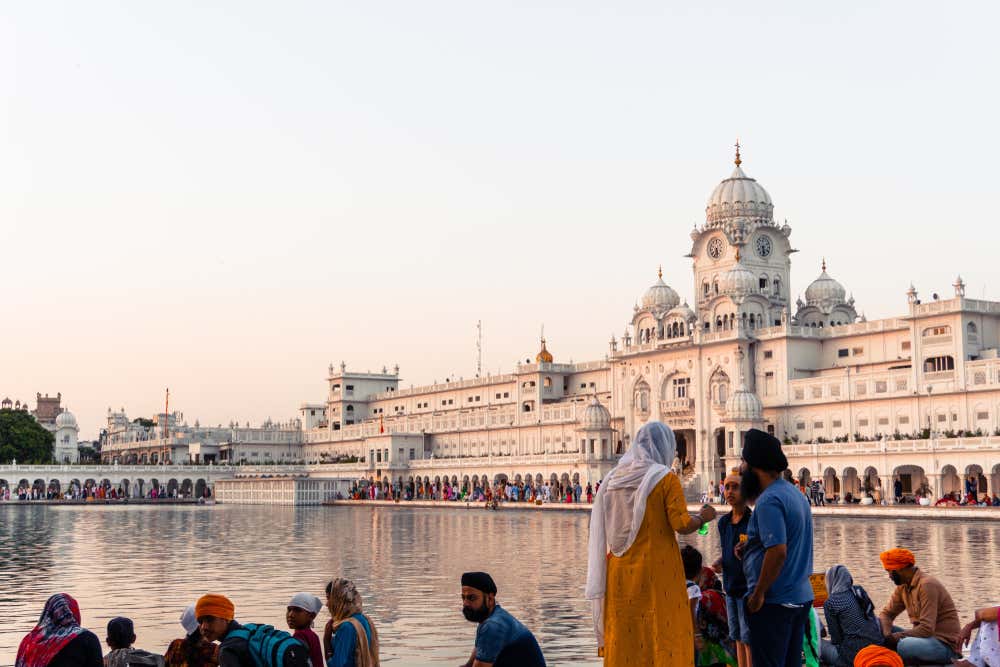
The Golden Temple is the most welcoming religious site in India, and that is not a small claim in a country full of them. Harmandir Sahib sits in the middle of a rectangular pool, gold leaf over marble, open on four sides to signal that anyone may enter. Pilgrims walk the perimeter at all hours. So can you, barefoot, head covered, at three in the morning if that is when you happen to be awake.
The kitchen behind it, the langar, feeds tens of thousands of people a day for free, every day, run almost entirely by volunteers. Sitting on the floor in a long row eating dal off a steel tray is, for a lot of travelers, the memory that outlasts the architecture.
Late afternoon, most visitors head about 18 miles (29 kilometers) west to the Wagah border ceremony, a piece of high-stepping military theater performed daily by Indian and Pakistani guards. Timings move with the sunset, so confirm locally on the day. The activities and day trips available in Amritsar cover both, along with the Jallianwala Bagh memorial nearby.
6. Ladakh
Ladakh looks like nowhere else in the country. Bare ochre mountains, a thin cold sky, Buddhist monasteries perched on outcrops above green barley fields. Culturally it has far more in common with Tibet than with the plains below.
Leh, the main town, sits at roughly 11,500 feet (3,500 meters), high enough that you should plan two easy days on arrival before attempting anything strenuous. From there the classic run is out to Pangong Tso, a lake at about 14,000 feet (4,250 meters) that changes color hour by hour. Thiksey Monastery, tiered up its hillside like a small Potala, holds a dawn prayer service that visitors are welcome to sit in on.
Season matters more here than anywhere else on this list. The high passes are typically open from June through September, and flights into Leh run year-round but are weather-dependent. Check current road status before committing to dates.
7. Rishikesh
Rishikesh is where the Ganges leaves the Himalayas and hits the plains, still cold and clear and moving fast. The Beatles came here in 1968, and the town has been trading on yoga ever since, but the ashrams predate them by centuries and the river does the real work.
Two suspension footbridges, Lakshman Jhula and Ram Jhula, connect the banks and rattle underfoot as scooters and cows share the crossing. Every evening at Parmarth Niketan, the Ganga Aarti sends oil lamps floating downstream while a few hundred people sing. It costs nothing and it is genuinely moving.
The whitewater season runs after the monsoon, roughly late September into May, with the biggest rapids upstream near Shivpuri. On foot, a guide helps you read what you are looking at. The Ganga Aarti spiritual walking tour explains the ritual as it unfolds, and the ashram tour of Rishikesh takes in the abandoned Beatles compound along with the working retreats.
8. Varanasi
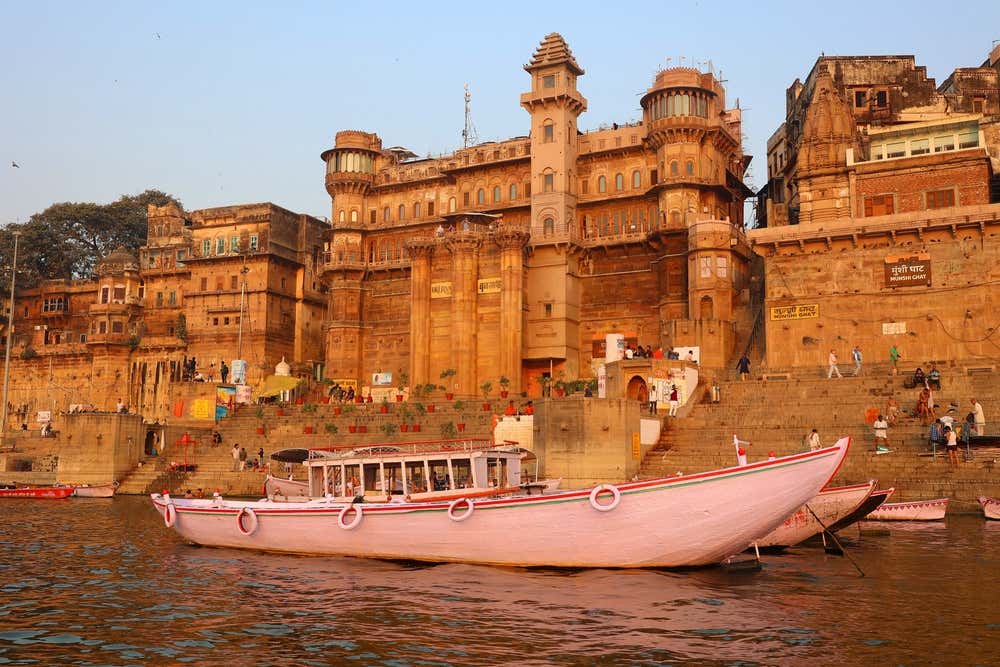
Varanasi is among the oldest continuously inhabited cities on earth, and it makes no effort to be easy. More than 80 ghats step down to the Ganges along a curve of about 4 miles (6.5 kilometers). At dawn, pilgrims bathe, dhobis beat laundry on the stones, and the light comes in flat and yellow across the water.
Hire a rowboat for sunrise. It is the single best hour in the city, and from the water you see the whole facade at once: the temples, the crumbling palaces, the cremation fires at Manikarnika that have burned more or less without pause for generations. Photography is not welcome at the burning ghats, and that boundary is worth respecting closely.
In the evening, Dashashwamedh Ghat hosts the Ganga Aarti, a choreographed fire ceremony that draws a large crowd nightly. Sarnath, where the Buddha gave his first sermon, is about 8 miles (13 kilometers) away and makes a calm half day. To find your footing in the old lanes, the free walking tour of Varanasi is a sensible start.
9. Darjeeling
Darjeeling sits at about 6,700 feet (2,045 meters) in the eastern Himalayas, close enough to Nepal, Bhutan, and Sikkim that the food and faces shift accordingly. The British built it as a hot-season escape and planted the hillsides with tea, which is still what the name means to most of the world.
The Darjeeling Himalayan Railway, a narrow-gauge line completed in 1881, became a World Heritage Site in 1999. The steam-hauled joyride from Darjeeling to Ghum takes roughly two hours and loops through the town at walking pace. Before dawn, jeeps run up to Tiger Hill for the view of Kangchenjunga, at 28,169 feet (8,586 meters) the third-highest mountain on the planet. Clear mornings are not guaranteed, so give yourself more than one shot.
Many travelers pair Darjeeling with Sikkim just to the north, where the monasteries at Rumtek and the lake at Tsomgo sit within a couple of hours of the capital. The tours and excursions based in Gangtok cover that side of the range.
10. Kolkata
Kolkata is the most literary city in India and behaves like it. Coffee houses on College Street still fill with people arguing about politics. Bookstalls run for blocks. The Bengali film and theater scene has been serious for a century and has no interest in explaining itself to outsiders.
The architecture is the giveaway that this was the British capital until 1911. The Victoria Memorial sits in open parkland, all white marble and domes, and the Howrah Bridge carries an astonishing volume of foot traffic across the Hooghly every day. Kumartuli, the potters’ quarter, is where the clay Durga idols are built by hand in narrow workshops you can walk straight into.
Time your trip for Durga Puja in the autumn if you can. UNESCO recognized it as intangible cultural heritage in 2021, and for five days the entire city becomes an open-air exhibition. The guided tours and food walks in Kolkata are a good way in, particularly for the street food, which deserves its reputation.
11. Mumbai
Mumbai was seven islands before the Portuguese, and then the British filled in the gaps. That history is still legible in the shape of the place: a long peninsula, water on both sides, and a skyline that jumps between Victorian Gothic and glass towers within a single block. You might sometimes here the city being referred to as Bombay, which was the name given to the city under British rule.
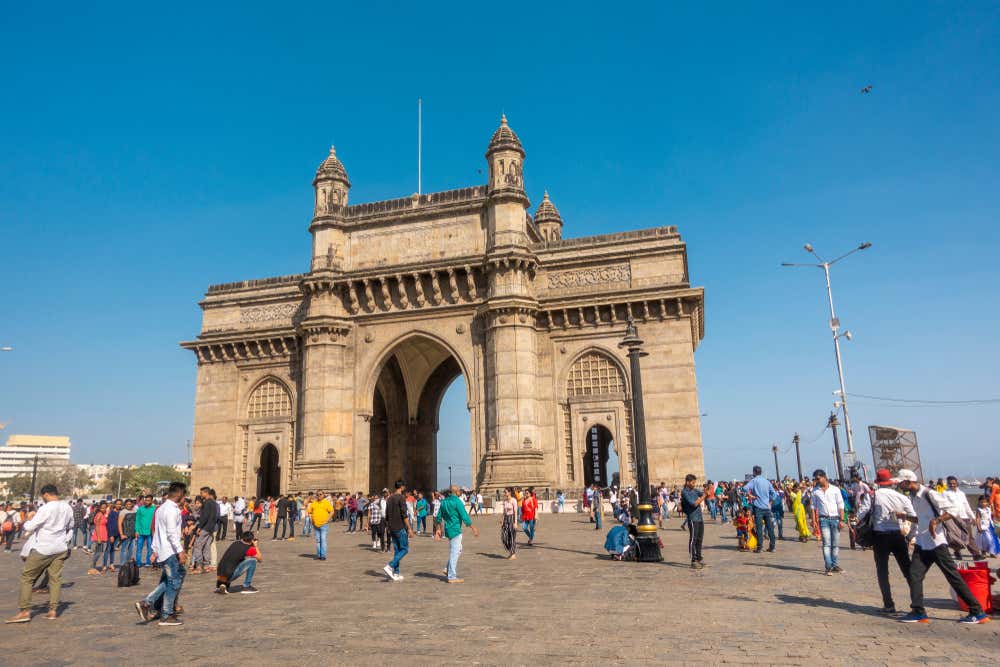
Start at the Gateway of India, completed in 1924, and walk north through the Fort district past the Chhatrapati Shivaji Terminus, a working railway station and a World Heritage Site. Marine Drive curves along the sea and fills up every evening with people doing nothing in particular. From the harbor, ferries run out to Elephanta Island, where rock-cut caves hold a twenty-foot Shiva carved in the sixth century.
Mumbai food is worth planning around: vada pav from a street cart, Parsi dishes at the old Irani cafes, and seafood in Colaba. The free walking tour of Bombay covers the colonial core, and it is the easiest orientation you will get in a city this large.
12. Hyderabad
Hyderabad is underrated by foreign visitors and adored by everyone who lives there. The old city grew around the Charminar, a four-minaret gateway built in 1591, and the lanes off it sell pearls, bangles, and perfume in about that order.
Golconda Fort, on a granite hill west of the center, was the seat of a diamond-trading dynasty and is built with acoustics so precise that a clap at the entrance carries to the summit. The Qutb Shahi tombs sit just beyond it in a quiet garden complex. Chowmahalla Palace, home of the Nizams, still has the durbar hall and a collection of vintage cars in the courtyard.
Then there is the food. Hyderabadi biryani is a distinct style, slow-cooked with the meat and rice layered raw, and the city will happily argue with you about where to eat it. The Hyderabad free walking tour takes in the Charminar and Chowmahalla Palace and sets you up nicely for the rest.
13. Goa
Goa was Portuguese until 1961, considerably longer than the British held anywhere else in India, and it shows in the churches, the tiled houses, and the vindaloo. The state is small, about 65 miles (105 kilometers) of coast end to end, and the character changes completely along it.
North Goa is the busy half: Anjuna, Vagator, Baga, night markets and beach shacks. The south is where the coast goes quiet, with Palolem and Agonda holding long crescents of sand and not much else. Inland, Old Goa keeps a cluster of World Heritage churches, including the Basilica of Bom Jesus, consecrated in 1605 and holding the remains of St. Francis Xavier.
Season is straightforward here. The shacks go up around November and come down before the monsoon arrives in June. The free walking tour of Panaji is the best hour you can spend on the Portuguese side of Goa, winding through the Latin Quarter of Fontainhas.
Fontainhas is painted in ochre, indigo, and green, a rule that dates back to Portuguese municipal law.
14. Kerala
Kerala is the gentlest introduction to India. Roughly 560 miles (900 kilometers) of interconnected canals, rivers, and lagoons run parallel to the Arabian Sea, and life along them moves at the speed of a punted boat.
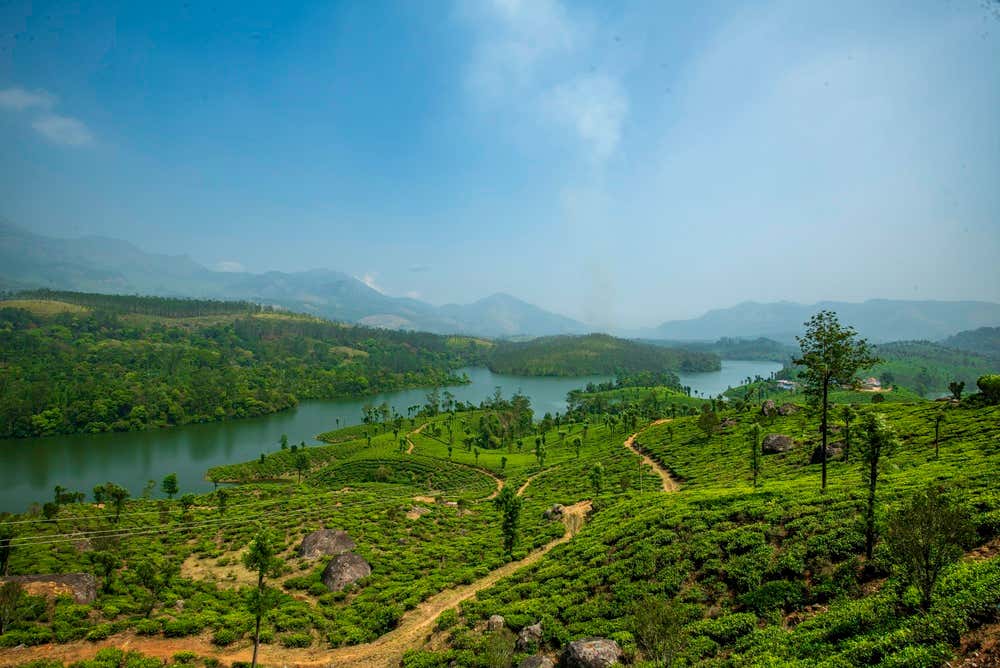
An overnight houseboat out of Alleppey is the classic version: a converted rice barge, a cook on board, and eight hours of watching kingfishers and school kids in canoes go past. Up in the hills, Munnar is wall-to-wall tea plantation, cool enough at 5,200 feet (1,585 meters) that you will want a jacket after dark. On the coast, Kochi holds the cantilevered Chinese fishing nets, a synagogue from 1568, and an arts scene that punches well above the city’s size.
Two or three nights is enough to do all three. Start with the backwater cruises and houseboat trips in Alleppey, then head inland for the tea estate walks and day trips around Munnar.
15. The Andaman Islands
The Andamans sit roughly 750 miles (1,200 kilometers) east of Chennai, closer to Myanmar than to the Indian mainland, and they feel like a different country. White sand, clear water, and dense rainforest running right down to the beach.
Radhanagar Beach on Havelock, officially Swaraj Dweep, is the one that turns up on lists of the best beaches in Asia, and it earns it. The diving is the real draw, with visibility that regularly exceeds 65 feet (20 meters) and reefs that are still in good shape. Neil Island, quieter again, is a short ferry hop further on.
Port Blair is the entry point, and the Cellular Jail there is worth a couple of hours for the history of the independence movement. Access rules for some outer islands change, so confirm current requirements before you fly. The calm season runs from November to April.
Ferries between Port Blair, Havelock, and Neil Island run several times daily and sell out in peak season.
When to go
India has no single best season, because the country covers too many climates. The broad rule is that October to March suits the plains and the south, while the Himalayan destinations open up in summer. Dates and opening hours shift, so confirm with an official source close to your trip.
| Destination | Best months | Worth planning around |
|---|---|---|
| Agra | October to March | The Taj Mahal closes on Fridays |
| Delhi | October to March | Winter mornings can be hazy |
| Jaipur | November to February | The Literature Festival fills hotels in January |
| Udaipur | October to March | Lake levels are highest after the monsoon |
| Amritsar | October to March | The Wagah ceremony starts late afternoon |
| Ladakh | June to September | High passes open once the snow clears |
| Rishikesh | September to May | Rafting season follows the monsoon |
| Varanasi | October to March | Dev Deepawali lights every ghat in November |
| Darjeeling | March to May, October to November | Clear Kangchenjunga views need a dry morning |
| Kolkata | October to March | Durga Puja transforms the city in autumn |
| Mumbai | November to February | Monsoon rain peaks from June to September |
| Hyderabad | October to March | Old city lanes are busiest after dark |
| Goa | November to February | Beach shacks close for the monsoon |
| Kerala | September to March | Backwater cruises run year round |
| Andaman Islands | November to April | Sea crossings are calmest outside the monsoon |
How long you need
Ten days covers the Golden Triangle comfortably: Delhi, Agra, and Jaipur, with a night or two spare for Ranthambore or Udaipur. Two weeks lets you add either Varanasi or a stretch of Kerala. Three weeks is where you can genuinely combine north and south without spending half of it in transit.
Internal flights make the long hops painless, and the overnight trains are an experience in their own right if you book a berth in advance. If you would rather not build the logistics yourself, the 4-day private Golden Triangle tour is the compact version, while the 8-day Golden Triangle and Ranthambore tour adds a tiger safari to the same circuit.
Trains between Delhi, Agra, and Jaipur run several times a day and cover each leg in a few hours.
Practical details before you fly
Most nationalities need a visa to enter India, and many can apply for an e-visa online well ahead of departure. Requirements change, so confirm the current rules with the relevant Indian embassy or consulate before you book anything.
A few other things that make the trip smoother. Dress modestly at religious sites, which means covered shoulders and knees, and expect to remove your shoes. Carry small notes, because change is perpetually scarce. Stick to bottled or filtered water. And sort out data before you land, since a working connection makes rickshaw fares and train platforms far less stressful. The Civitatis eSIM card for India covers you from the airport onward.
Prices and opening hours listed by any operator can change seasonally, so check directly before travel.
Choosing your route
The mistake almost everyone makes on a first trip to India is trying to see too much of it. The country rewards depth rather than distance, and a week spent properly in Rajasthan will stay with you longer than a fortnight of airports.
Pick the two regions that pull at you hardest, build the rest around them, and leave a day or two unplanned for the things you will inevitably hear about once you arrive. When you are ready to start filling in the gaps, Civitatis’s full catalog covers guided tours, day trips, and transfers across every destination on this list.


Most read of #More of Asia
What is a Free Tour & How Much do They Cost?
16 October 202615 Bucket List Travel Experiences to Gift in 2026
14 October 2026What to Do in Athens: 11 ‘Musts’ in the Greek Capital
13 October 2026Top 11: What to Do in Belize in 2026
12 October 202611 Unmissable Day Trips from Rome (& How to Get There)
11 October 2026Top 12: What are the Best Things To Do in NYC With Kids? (2026)
10 October 2026Most read #United States

Iconic Food in Chicago: 17 Dishes You Have to Try
30 September 2026Best Time to Visit Hawaii: A Season-by-Season Guide
29 September 2026
NBA Game Tickets in New York: A Complete Guide
3 June 2026Top Fun Facts About New York
3 June 2026
The Ultimate 3-Day Boston Itinerary for First-Time Travelers
14 January 2026Top 11: Best Day Trips from Miami (2026)
10 January 2026The 12 Best Day Trips from Los Angeles (+ Travel Time)
22 November 2025Top 11: Things to Do in Las Vegas Besides Gambling
14 February 2025Top 10: Things to Do in Washington, DC
22 November 2024