15 Famous Landmarks in Mexico, from Maya Ruins to Canyons

Mexico has 35 UNESCO World Heritage Sites, more than any other country in the Americas. Some are pyramids that were already ancient ruins when the Spanish arrived. Others are canyons, petrified waterfalls, and a canal system that has been farmed continuously for six hundred years.
The most famous Mexico landmarks range from Chichén Itzá and the pyramids of Teotihuacán to the clifftop Maya port at Tulum, the Zapotec capital on a leveled mountaintop at Monte Albán, and Copper Canyon in the northern sierra. Most are open year-round.
Below are 15, ordered by how many people go looking for them. They’re spread across the whole country, so treat this as a menu for several trips rather than one. You’ll notice climbing rules have tightened at nearly every ancient site, which is worth knowing before you build your hopes around a photograph.
1. Chichén Itzá, Yucatán
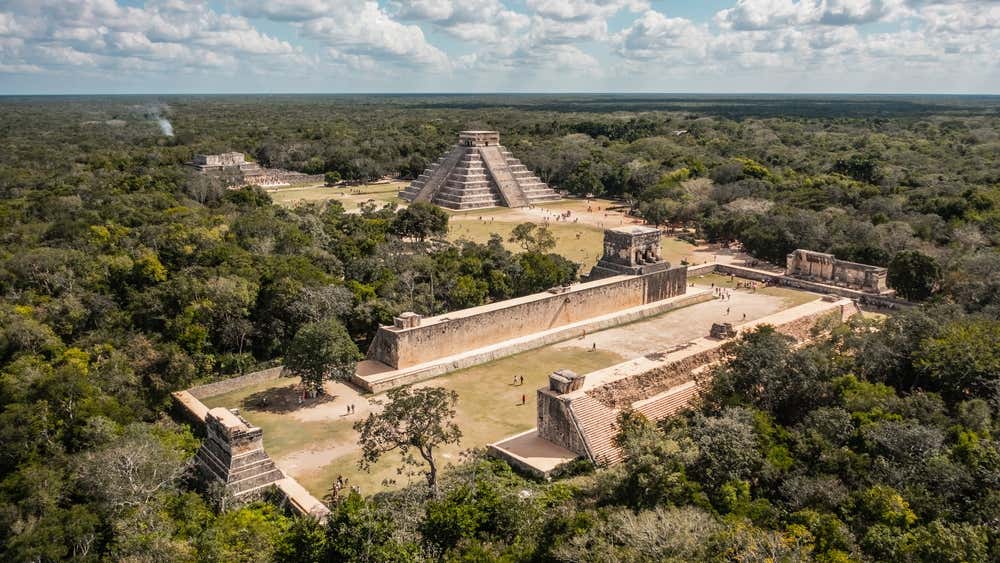
El Castillo, the stepped pyramid at the center, is a calendar built in stone. Each of its four staircases has 91 steps, and with the top platform they total 365. Twice a year at the equinoxes, the afternoon light throws a shadow down the northern balustrade that looks exactly like a serpent descending.
UNESCO listed the site in 1988, and it was voted one of the New Seven Wonders in 2007, so expect company. You’ll also find the largest ball court in Mesoamerica, where the acoustics carry a whisper the length of the field, and the Sacred Cenote where offerings were thrown.
Nobody has been allowed to climb the pyramid since 2006. Go at opening time to beat both the heat and the tour buses. The Chichén Itzá, Cobá and Ik Kil cenote day trip covers three stops in a day, or the Chichén Itzá and Chichikan cenote trip adds the colonial town of Valladolid.
2. Teotihuacán, State of Mexico
Here’s the strange part: nobody knows who built it. The city was already abandoned ruins by the time the Aztecs found it centuries later, and it was they who named it Teotihuacán, the place where the gods were born. The people who actually laid it out left no name for themselves.
At its height, it may have held 125,000 people, which made it one of the largest cities on earth. The Pyramid of the Sun rises about 216 feet (66 meters), and the Avenue of the Dead runs straight through the middle for over a mile, lined with platforms and temples.
It’s roughly 30 miles (48 kilometers) northeast of Mexico City, and climbing the pyramids is now prohibited. The Teotihuacán pyramids day trip gets you there first thing before the crowds, and the Teotihuacán, Basilica of Guadalupe and Tlatelolco day trip combines it with two more landmarks over about eight and a half hours.
3. Xochimilco, Mexico City
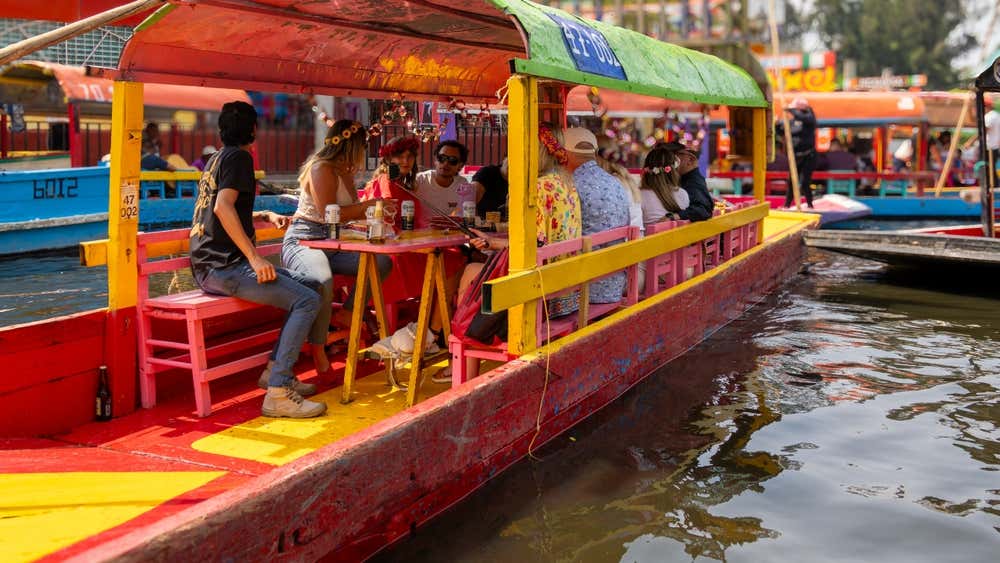
Mexico City was built on a lake, and the Spanish drained almost all of it. Xochimilco is what survived: about 110 miles (177 kilometers) of canals threading between chinampas, the rectangular artificial islands the Mexica built by staking out reed frames and filling them with lake mud.
They still grow food. Six hundred years on, the chinampas remain some of the most productive farmland in the country, which is why UNESCO listed the canals alongside the city’s historic center in 1987.
You’ll ride a trajinera, one of the flat-bottomed boats painted in hard candy colors, poled along by a boatman while mariachi boats pull alongside. Weekends are a party and weekdays are peaceful, so pick according to taste. The Coyoacán, Xochimilco and Frida Kahlo Museum tour pairs the canals with the neighborhood.
4. Palenque, Chiapas
Palenque is the one that gets under people’s skin. It sits where the Chiapas highlands drop into the Gulf plain, wrapped in rainforest, and howler monkeys make a noise from the canopy that you will not forget. Mist sits in the trees most mornings.
In 1952 the archaeologist Alberto Ruz Lhuillier lifted a slab in the Temple of the Inscriptions and found a hidden staircase packed with rubble. It took four years to clear. At the bottom was the intact tomb of K’inich Janaab’ Pakal, under a carved sarcophagus lid that people have been arguing about ever since.
Only a fraction of the city has been excavated, and the rest is still under the forest. UNESCO listed it in 1987. Go early, take water, and accept that you’ll be damp within the hour.
5. Monte Albán, Oaxaca
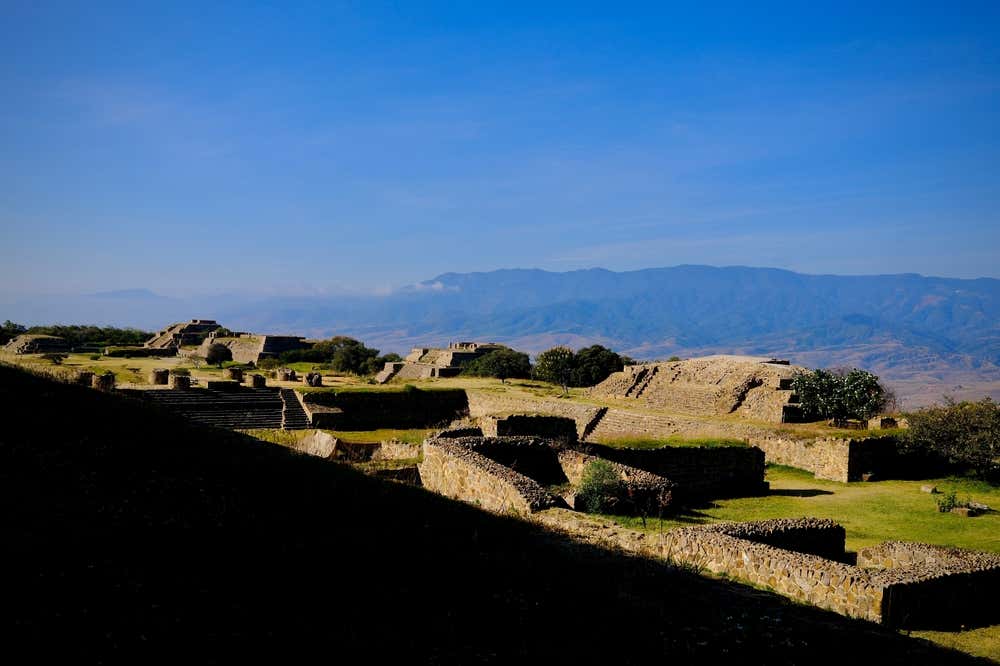
The Zapotecs didn’t build on a mountaintop so much as build the mountaintop. Around 500 BC they flattened an entire ridge about 1,300 feet (400 meters) above the valley floor to make a level plaza, then raised temples around its edges.
What you’ll remember is the view. From the plaza you can see three arms of the Oaxaca valley at once, which was rather the point for a capital that ran the region for more than a thousand years.
Look for the Danzantes, carved stone figures in contorted poses that were long read as dancers and are now generally understood as captives. The site is a short drive from Oaxaca city and pairs easily with a morning in the markets.
6. Tulum, Quintana Roo
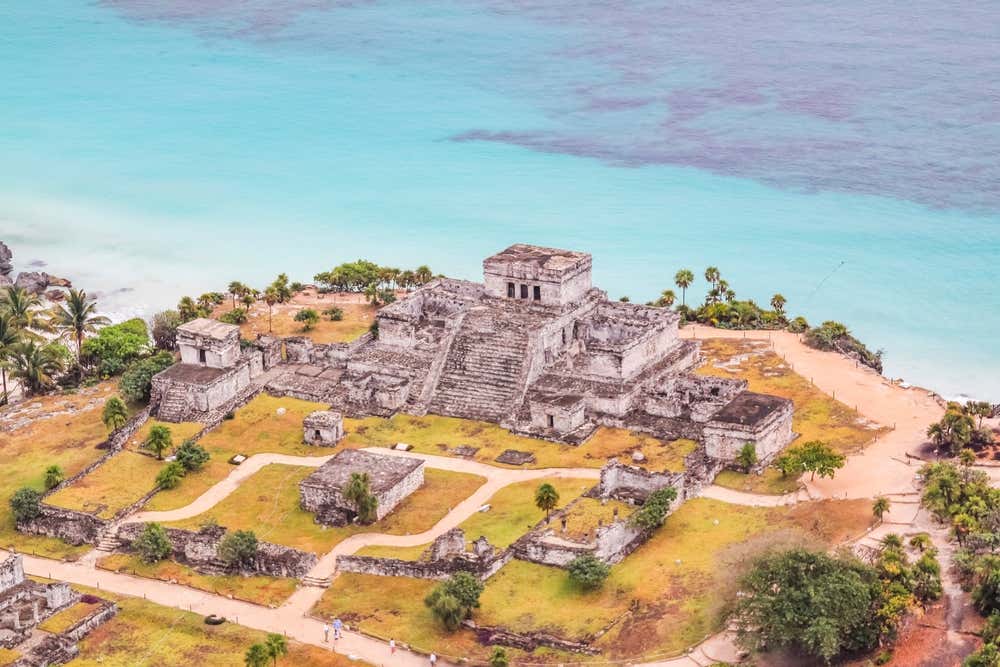
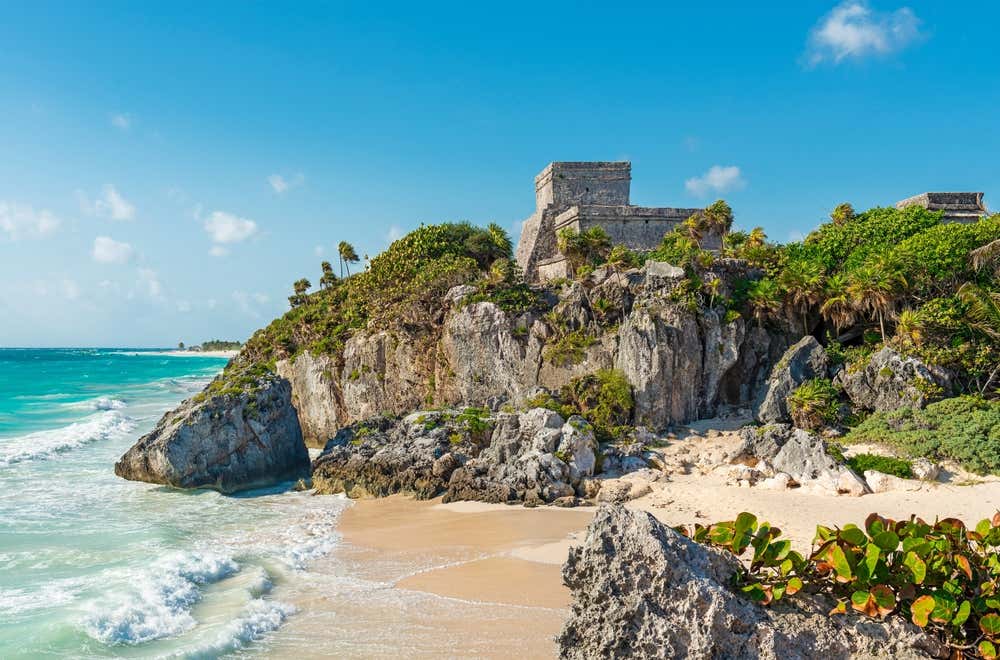
Of all the major Maya cities, this is the only one built on the coast, and the setting does most of the work. El Castillo stands on a limestone bluff about 40 feet (12 meters) above the Caribbean, with white sand and turquoise water directly below it.
It was a working port, walled on three landward sides, trading obsidian and jade up and down the coast. It was also one of the last Maya cities still occupied when the Spanish arrived, who recorded seeing it from their ships.
The site is compact, and you’ll cover it in ninety minutes, but there is no shade at all, so go at opening. The two-day Chichén Itzá and Tulum combo from Cancún takes both on consecutive days with cenote swims included.
7. Popocatépetl, Puebla and Morelos
At 17,802 feet (5,426 meters), Popocatépetl is Mexico’s second highest peak and one of its most active volcanoes. On a clear morning you can see it from Mexico City, smoking gently, which is a genuinely startling thing to notice from a traffic jam.
Beside it lies Iztaccíhuatl, whose ridgeline looks like a sleeping woman. The Nahua story says he was a warrior and she a princess, that she died believing him killed in battle, and that the gods turned them both to mountains so he could watch over her.
The volcano itself is closed to climbers because of ongoing activity, and an exclusion zone is enforced. What you can visit are the 16th-century monasteries on its slopes, UNESCO-listed in 1994. Check current volcanic alert levels before traveling in the area.
8. Basílica de Guadalupe, Mexico City
This is the most visited Catholic shrine in the world after St Peter’s, and on December 12 several million pilgrims arrive over a single weekend, many of them covering the last stretch on their knees.
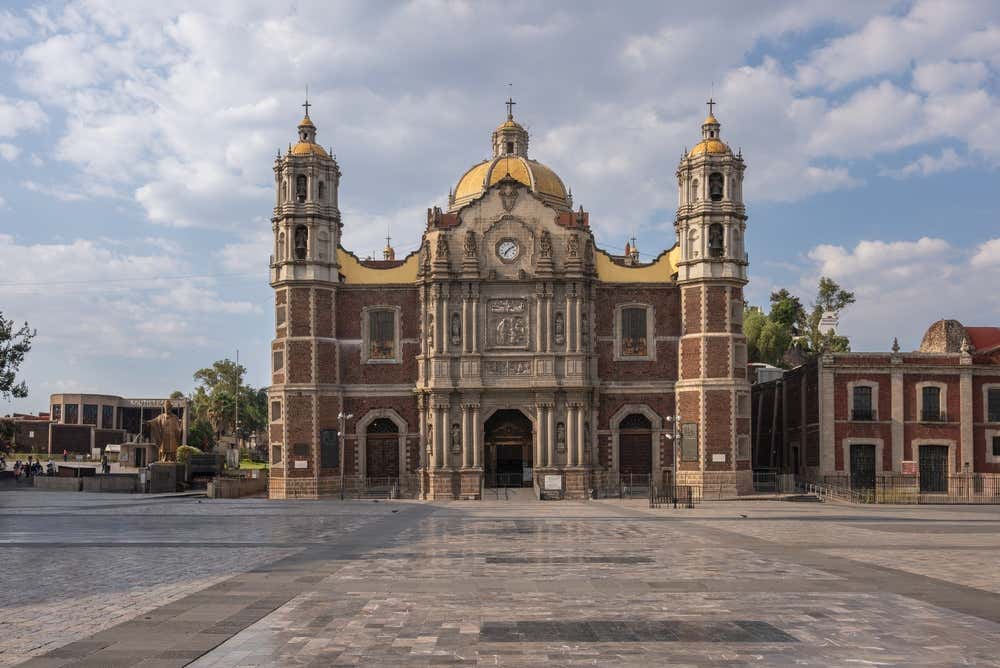
The tradition holds that in 1531 the Virgin appeared to Juan Diego on Tepeyac Hill and left her image on his cloak. That cloak hangs behind the altar of the modern basilica, and a moving walkway carries you past it so the line keeps flowing.
The old basilica next door is visibly tilting as the lakebed subsides beneath it, which is why the round modern building went up in 1976, designed by the same architect as the Anthropology Museum. It’s included on the Teotihuacán and Basilica of Guadalupe day trip.
9. Uxmal, Yucatán
If Chichén Itzá is the famous one, Uxmal is the beautiful one. It’s the finest surviving example of Puuc architecture, where plain lower walls carry elaborately mosaicked upper facades, assembled from thousands of precisely cut stones.
The Pyramid of the Magician is unlike anything else in the Maya world, with rounded corners and an unusually steep profile. Nearby, the Governor’s Palace runs for almost 330 feet (100 meters) and is covered in stacked masks of Chaac, the rain god, which mattered here because there are no cenotes and the city depended on stored rainwater.
It’s about 50 miles (80 kilometers) south of Mérida and sees a fraction of Chichén Itzá’s crowds. UNESCO listed it in 1996.
10. Hierve el Agua, Oaxaca
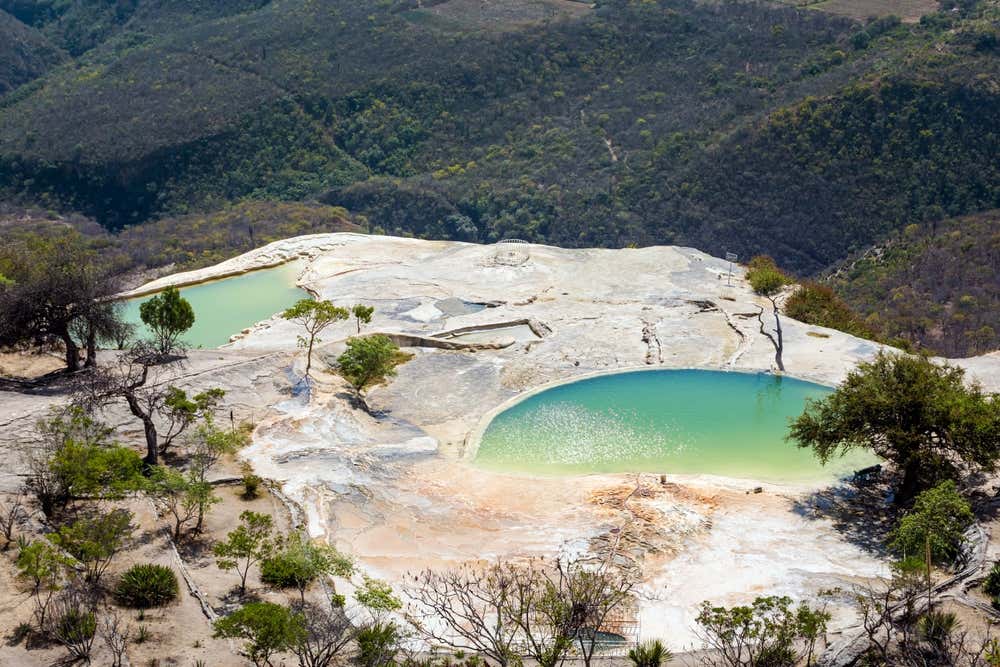
Two frozen waterfalls hang off a cliff edge here, except they aren’t frozen and they never moved. Mineral-heavy spring water has run over the rock for thousands of years, depositing calcium carbonate, and the result looks exactly like a cascade caught mid-fall.
The name means “the water boils,” which is also misleading. The springs bubble up cold. At the top are natural pools you can sit in, looking out over the Sierra Madre with nothing much in the way.
Access has been interrupted in the past by disputes between local communities, so it’s worth confirming the site is open before you make the drive from Oaxaca city. Bring cash for the community entrance fee.
11. Copper Canyon, Chihuahua
Barrancas del Cobre isn’t one canyon but a network of six, and taken together the system is larger than the Grand Canyon and deeper in several places. Almost nobody outside Mexico has heard of it.
The way to see it is the Chepe, the railway from Chihuahua to the Pacific coast, which crosses 37 bridges and passes through 86 tunnels on its way through the sierra. It’s one of the last great passenger train journeys anywhere.
This is Rarámuri country, the people known worldwide for long-distance running, who have lived in these canyons for centuries and still farm the terraces on the slopes. Book train seats well ahead in high season.
12. Ek Balam, Yucatán
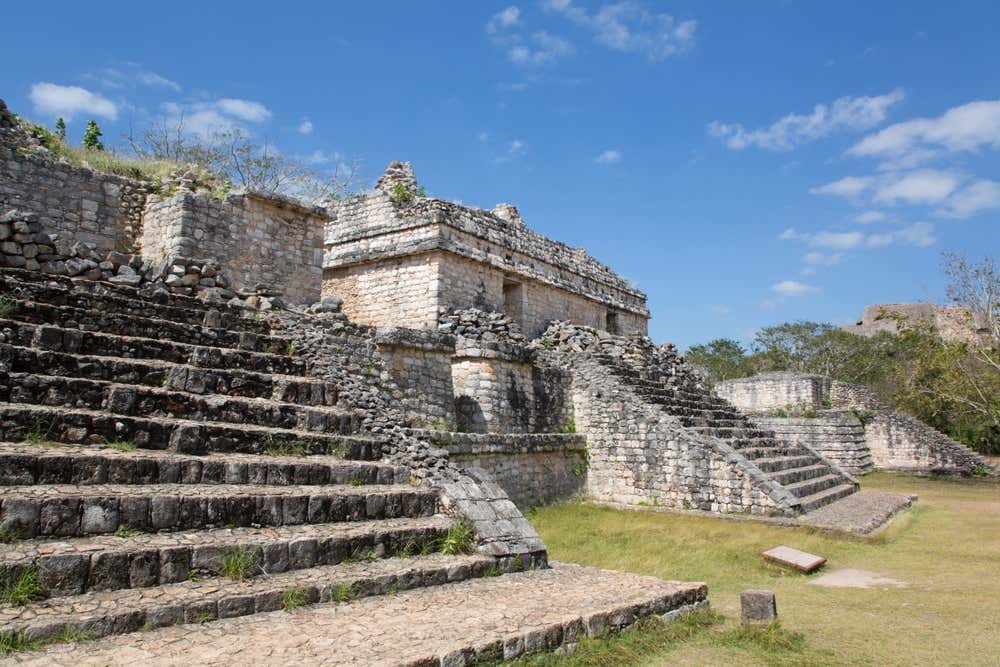
Ek Balam means black jaguar, and its appeal is simple: you can still climb it. The Acropolis is one of the largest Maya structures in the Yucatán, and the steps to the top are open in a way that Chichén Itzá and Teotihuacán no longer are.
Partway up you’ll find El Trono, a stucco frieze that was sealed under rubble for a thousand years and survived almost perfectly. Winged figures flank a doorway carved as a monster’s open jaws, and the detail is startling this close.
It’s a half hour north of Valladolid and quiet even in season. Combine it with a cenote swim, and you have an easy half day.
13. The Zócalo, Mexico City
The Plaza de la Constitución, generally referred to as the Zócalo, is one of the largest city squares in the world, and it has been the center of power here for seven hundred years, first as the ceremonial heart of Tenochtitlan and then as the seat of the colony.
Three landmarks face onto it. The Metropolitan Cathedral is the largest in the Americas and took 240 years to build, which is why its styles don’t match. The National Palace holds Diego Rivera’s staircase murals covering the whole sweep of Mexican history. The Templo Mayor sits excavated on the northeast corner.
You can cover all three on foot in a morning. Start with a ticket to the Templo Mayor Museum, and the Choco Story museum is a few steps off the square if you have children with you.
14. Cenote Ik Kil, Yucatán
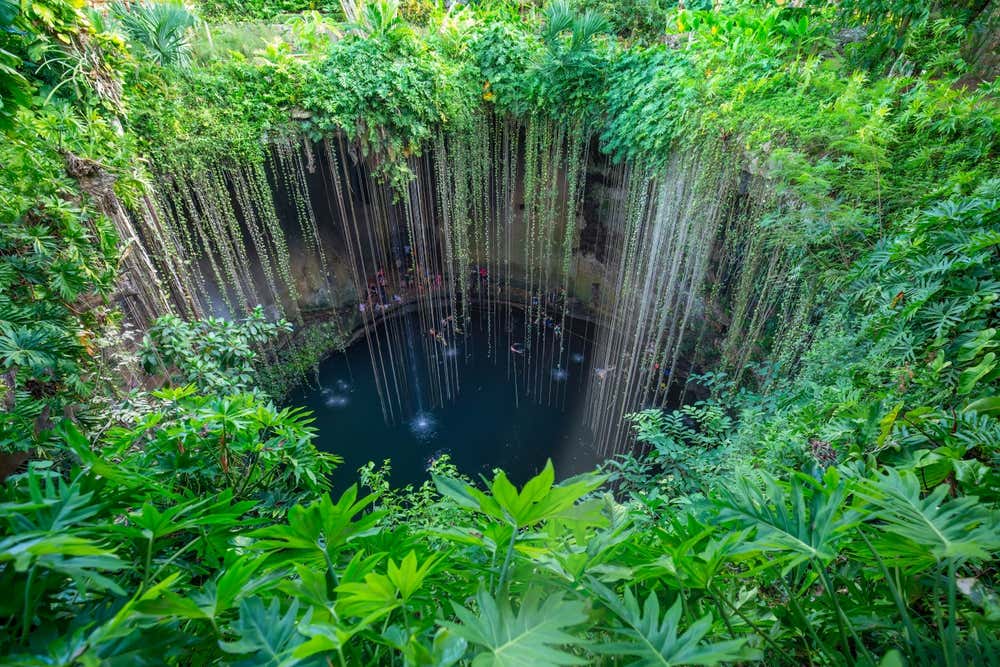
The Yucatán has no rivers. Rain drains straight through the limestone, and where a cave roof has collapsed you get a cenote, a natural well open to the sky. There are thousands across the peninsula, and the Maya considered them entrances to the underworld.
Ik Kil is the photogenic one: a near-perfect circle about 85 feet (26 meters) below ground level, with vines and tree roots hanging all the way down to the water and a carved staircase spiraling in.
It’s minutes from Chichén Itzá, which is both convenient and the reason it gets busy at midday. Swimming is allowed, and life jackets are provided. You’ll find it included on the Chichén Itzá, Cobá and Ik Kil day trip.
15. Sumidero Canyon, Chiapas
The Grijalva River runs through a gorge whose walls rise as much as 3,300 feet (1,000 meters) more or less straight up. It appears on the coat of arms of Chiapas, and seeing it from the water explains why.
Boats leave from Chiapa de Corzo for a two-hour run upriver. You’ll pass crocodiles on the banks, spider monkeys in the trees, and the Christmas Tree, a moss-covered rock formation fed by a seasonal waterfall that really does look like one.
There are clifftop viewpoints on the road above too, if you’d rather look down than up. It’s a straightforward day out from San Cristóbal de las Casas.
How to Group Them
Mexico is big enough that ambition works against you. Pick one base, take everything within a day of it, and you’ll see far more than someone trying to cross the country in a fortnight.
Mexico City is the most efficient base of the six, with four of these landmarks inside a day’s reach. The Civitatis guide to the best day trips from Mexico City covers what else is in range, and if you’d rather shape a route around towns than ruins, start with the roundup of the best cities to visit in Mexico.
When to Visit and What to Know
The dry season runs roughly November to April and suits the archaeological sites best, since walking open ruins in August heat is hard work. Rain in summer usually comes as an afternoon downpour rather than an all-day soaking.
Nearly all major sites are managed by INAH and share a pattern: open daily from around 8 or 9 AM to 5 PM, with the last entry an hour before closing. Hours and prices are subject to seasonal changes, so confirm with the official source before you plan a long drive around one.
Entry requirements differ by nationality, and some travelers need a visa, so check with the Mexican embassy or consulate in your country. Sundays are free at INAH sites for Mexican nationals and residents, which makes them the busiest day of the week.
Plan Your Trip to Mexico
What connects these places is depth of time. You can stand in a Zapotec plaza laid out before Rome was an empire, then drive an hour to a market that has been trading on the same ground ever since. Very few countries let you feel the layers that clearly.
Pick a base, take the landmarks within reach of it, and save the rest. You’ll find guided visits and day trips to most of them in the full range of tours and activities in Mexico, with the deepest choice around Mexico City and Cancún.
Book the big sites before you arrive, and you’ll spend your mornings at the ruins rather than the ticket window. Everything is available through Civitatis’s full catalog of activities in English all over the world.


Most read of #North America
Top 10: The Best Cities to Visit in Mexico (2026)
9 October 2026The 8 Best Day Trips from Philadelphia in 2026
8 October 2026Iconic Food in Chicago: 17 Dishes You Have to Try
30 September 2026Best Time to Visit Hawaii: A Season-by-Season Guide
29 September 202615 Best Things to Do in Mérida, Mexico
25 September 2026Cancun Beaches: The 9 Best Spots for Sun and Sand
25 September 2026Most read #North America
Top 10: The Best Cities to Visit in Mexico (2026)
9 October 2026The 8 Best Day Trips from Philadelphia in 2026
8 October 2026Iconic Food in Chicago: 17 Dishes You Have to Try
30 September 2026Best Time to Visit Hawaii: A Season-by-Season Guide
29 September 202615 Best Things to Do in Mérida, Mexico
25 September 2026
11 Pueblos Mágicos Near Mexico City Worth the Trip
23 September 2026Oaxaca Beaches: 10 Best Spots on the Pacific Coast
22 September 2026Best Time to Visit Tulum: Weather, Crowds and Sargassum
12 September 2026Cancún to Isla Mujeres: Ferry, Catamaran and Costs
11 September 2026
What to See in Jalisco in 2026: Lake Chapala, Tequila & More
31 August 202614 Best Places to Visit in Canada
28 August 2026What to See in San Luis Potosí, Mexico: 11 Highlights
14 August 2026The 10 Best Things to Do in Puerto Vallarta, Mexico
14 August 2026
15 Famous Landmarks in Mexico, from Maya Ruins to Canyons
12 August 2026The 14 Most Beautiful Places to Visit in Canada
11 August 202616 Best Things to Do in Querétaro, Mexico
10 August 2026Top 11: The Best Day Trips from Mexico City (2026)
5 August 2026